 Report · World Listens
A n unruly rabble bursts on to the street: a noisy eruption, bubbling towards us. This isn’t closing time on the Croisette in Cannes. A flock of sheep bustles past our cottage towards the shade of a huge chestnut tree, driven by three generations of herders and their dogs.
The waterlike cacophony of their bells slows until only the odd tink tink punctuates the cicadas’ hum. The sheep graze, the shepherds doze off, and the mountain hamlet is still again. My partner and I had set off by Eurostar less than 24 hours before, yet this place felt a world away from the ad agency where I work.
We’d booked cheap tickets to Paris months ago, intending to plan a trip on from there by train. As our departure approached, Instagram seemed to be full of aspirational, yet similar, holiday photos, and almost every other TikTok post I flicked past offered the promise of a hidden destination ... discovered. I find ratings, reviews and recommendations just as reassuring as the next person, especially when faced with a limited holiday allowance.
The safety of the search bar helps to give me the confidence that I’m spending my hard earned money as wisely as possible. I work in a world that runs on data and optimisation and I love it, but I wondered whether I’d optimised the adventure out of my own holidays. So, we tried a simple experiment.
We closed down the tabs and opened a map of western Europe. Embracing a bit of low-tech randomness, we chose to let chance decide our trip. I shut my eyes and we promised to go wherever my finger landed.
I waved my hand like a magic wand and pointed, then took a deep breath, eyes still closed. What if we ended up in some industrial wasteland? But we were in luck.
My finger landed upon the commune of Saint-Hilaire-de-Lavit in Cévennes, a place we’d never heard of and almost certainly would never have found by searching “places to go in France”. A shepherd and flock in Les Ayres. Photograph: Camilla Yates After overnighting in Paris, a three-hour fast train zipped us down to Montpellier, where we hired a car.
We stopped for provisions in a Lidl on the edge of town, stocking up for the whole trip – we weren’t expecting to find any shops at our journey’s end. A short drive inland, and the roads began to get narrower and more sparsely populated. As they climbed and zigzagged into this south-east corner of the Massif Central, we entered a south of France far removed from the honeypots served up by algorithms.
We pulled into a grassy layby on a high mountain pass where there was one other car parked. Had we arrived? We’d followed the cottage owner’s directions as there was no signal here for Google Maps, so it was hard to tell.
Stretching our legs in the fresh, cool air, the first thing we noticed was the quiet. No traffic, no tourists. Just stillness.
But the languid buzz of big insects flying by and the whirring chorus of cicadas told us this place was alive. Squinting into the low sun, we saw someone waving. Our host, Guilaine, had appeared as if by magic and was beckoning us to the cottage a little farther down the road.
We had found the hamlet of Les Ayres: a cluster of maybe 10 stone buildings, 800 metres above sea level. The rough-walled dwellings huddled either side of the narrow road, making the most of the tiny strand of level ground before the mountain’s spine fell away into steep forest. A long wooden awning and some outdoor tables suggested a cafe opposite our cottage, but the building was shuttered, and Les Ayres’ only potential customers seemed to be ourselves and Guilaine.
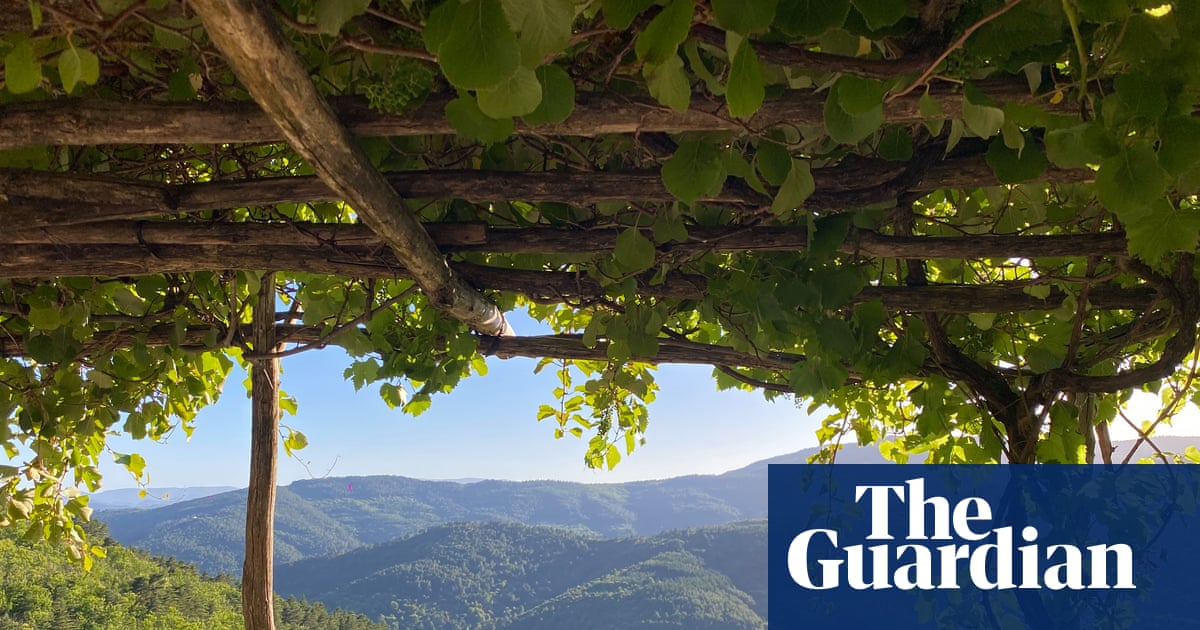
She took us to the back of our accommodation, to a veranda that looked out over chestnut and pine-clad mountains rolling into the horizon. It’s a landscape that appears wild but has actually been shaped by farming, forestry and the seasonal movement of livestock for thousands of years. The next morning, as I watched the sheep and their guardians settle down in the shade, I felt the ancientness of the place.
Shepherds must have moved their flocks along the same path and most likely slept under the same chestnut trees for centuries. Traditional farming practices endure here in part because the area is veined with crystal-clear mountain streams, meaning animals traversing the paths are never too far from a drink. So rather than opening the internet, we let these ancient tracks, known as drailles , guide our hikes. skip past newsletter promotion after newsletter promotion ‘We discovered that shady, secluded river pools were waiting for us on all the paths that led down from our cottage.’ Photograph: Camilla Yates We took sweaty, daylong expeditions without seeing another human or hearing the sound of cars.
The forests protected us from the worst of the sun’s blaze but, on our first trek, the real treat came when we rounded a corner to find that what we thought was the sound of wind in the pines was actually water gushing through a narrow gorge below us. Another couple of switchbacks and we arrived at a deep, clear pool created as the stream carved a corner into the rock. Dappled sunlight filtered down through trees clinging to the steep-sided valley, creating spotlights for damselflies to dart through.
We stopped for a picnic and a swim in the freezing mountain water, picking wild strawberries from the bank for dessert. We discovered that these shady, secluded river pools were waiting for us on all the paths that led down from our cottage. As well as being the ultimate pit stops for mid-hike refreshment, they were teeming with wildlife – tadpoles wriggled in the shallows, fish flickered in the depths and a huge variety of butterflies, dragonflies and other insects skimmed the surface.
We even saw a snake swimming across water we’d been submerged in just minutes before. We spent our last afternoon reading on a rock, summoning the energy to walk back up the mountain (one drawback of staying high up on a pass). We watched the sun swing over the water and the light change as the day wore on.
When the air began to cool, we worked our way back towards the cottage. As the path turned into an empty, single-track road, a car approached – a big event after so much seclusion. It was Guilaine – the only person apart from the shepherds we’d encountered.
In the evening, as the light faded, the sound of brass band practice drifted towards our veranda. Later, owls called to each other and a distant wild boar screeched into the quiet night. None of this had appeared in my search results.
There was no review promising unexpected trumpeting, no listicle recommending the best pool for swimming among tadpoles, and no algorithm that could have told me where the sheep would pass on that first morning. We hadn’t looked at our phones for days – maybe that was the real discovery.
Source: The Guardian