 Report · World Listens
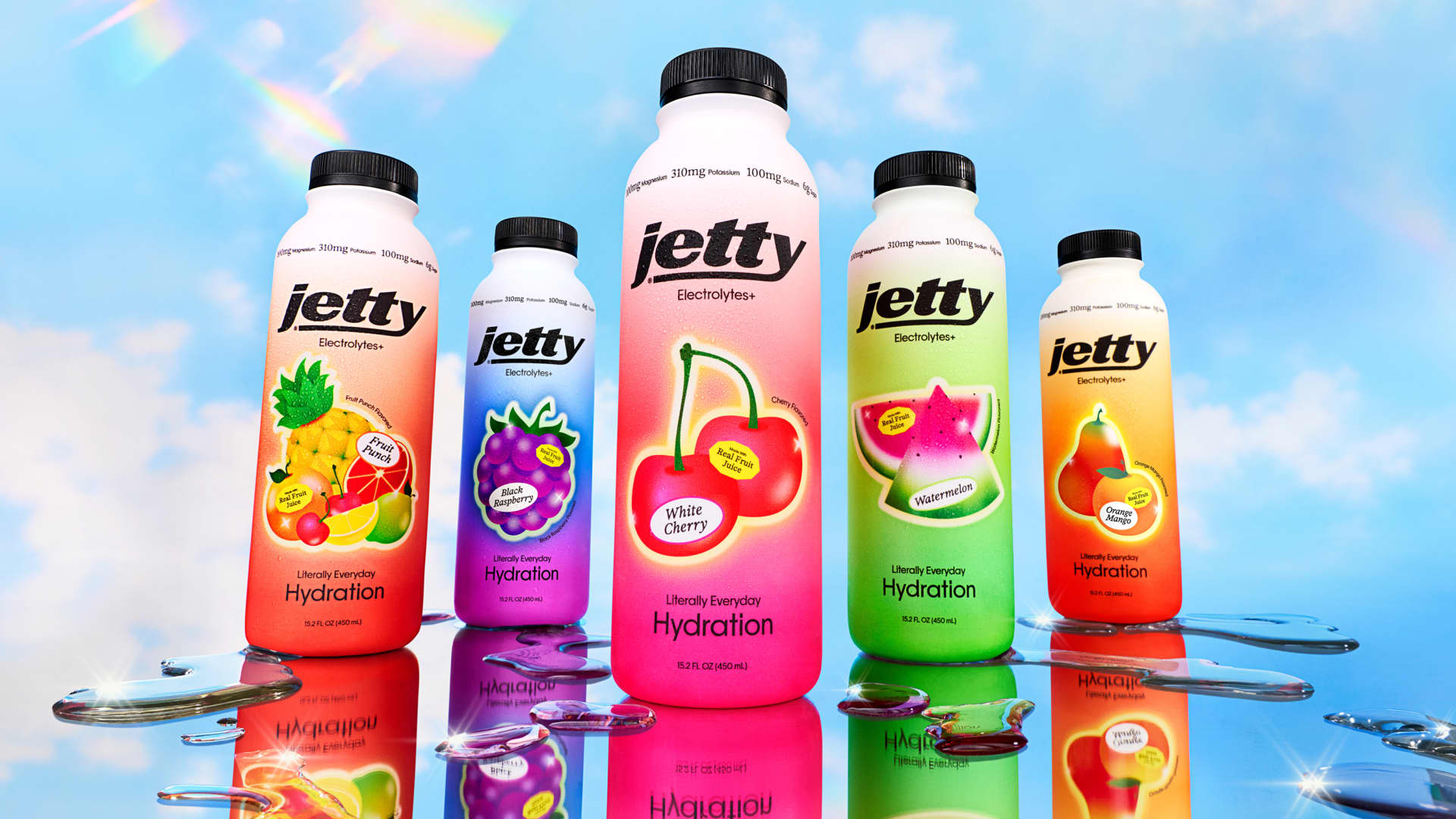
Jetty, the new drink brand from the founders of Poppi, is launching with five flavors. Source: Jetty After disrupting the soda category with Poppi, founders Allison and Stephen Ellsworth are now taking aim at hydration with their new brand, Jetty. Starting Monday, Jetty drinks and ready-to-mix electrolyte packets will be on shelves at Whole Foods grocery stores and available online at Target and Amazon .
The new, self-funded venture directly pits the Ellsworths against PepsiCo , which bought Poppi for $1.95 billion in 2025. Pepsi owns Gatorade, which dominates the U.S. sports drink category with about 60% market share, according to Numerator data. Poppi shook up the soda category with prebiotic fiber, low calorie and sugar counts and its fun marketing aimed at Generation Z and millennials.
Jetty looks to upend the hydration category through a similar strategy. To do so, it will face off not only against Gatorade but also a swarm of other upstarts looking to get in on the electrolyte-fueled trend. For decades, Gatorade and other sports drinks have pitched their products to athletes who need electrolytes and fluids after an intense workout, although many consumers drink them every day without even sweating.
Jetty is aimed at people who need a hydration boost, but not the same level of electrolytes or sugar as a traditional sports drink. "No one has really created a product for just everyday hydration — literally everyday hydration for normal people," Allison Ellsworth, Jetty's chief brand officer, told CNBC. "Like I woke up this morning, I didn't run a marathon." The GLP-1 hydration dilemma Poppi co-founder Allison Ellsworth.
She and her husband, Stephen, are launching a new drink brand, Jetty. Jetty Following Poppi's sale to PepsiCo, Ellsworth stayed on as an advisor to the brand, although she said she is no longer involved in the day-to-day operations. After 10 years building Poppi, Ellsworth said, she finally had free time.
As Ellsworth tells it, she went to the doctor for the first time in a decade. She started using a GLP-1 medication and lost 60 pounds. That's how Jetty came to be.
Ellsworth's husband, Stephen, now CEO of the new brand, noticed she wasn't hydrating, even when she came back from the gym. GLP-1 medications such as Ozempic and Mounjaro can make people less thirsty. But because staying hydrated can also help mitigate some of the drugs' side effects, such as nausea and headaches, it can become more important.
"I physically struggle getting liquid into my body," Ellsworth said. Jetty is meant to solve that problem. Plain old water is often less appealing to consumers, even dehydrated GLP-1 users, but more flavorful options with added benefits can be tempting.
About 44% of GLP-1 users report consuming more functional beverages, according to EY-Parthenon's third annual survey of more than 3,600 current or former GLP-1 users. Ellsworth sees a broader appeal for Jetty, too. "Our core audience is going to be millennial moms and Gen Z," she said.
"Gen Z just isn't relating to these old school brands, the legacy of the Gatorades and the Powerades. They're just not cool." Electrolyte elevation Consumers broadly have become more interested in staying hydrated. Dollar sales of hydration and electrolyte products climbed 20% to $2.6 billion over the 52 weeks ended Oct. 4, based on data from SPINS, which tracks new universal product codes, or UPCs.
The category also has a strong repeat buyer rate of 62%. However, the Ellsworths aren't the only ones to notice the potential in hydration. The number of new items in the category with annual sales of at least $10,000 has increased 41% over the last two years, according to SPINS.
Big food and beverage companies have been looking to hydration, too. Kraft Heinz debuted Capri Sun juice pouches and Kool-Aid packets with electrolytes this spring. In April, Pepsi unveiled an overhaul of the Gatorade brand, focused on making it more appealing to a wider swath of consumers, with more potential occasions like a "fresh morning start" or an "afternoon walk." And Electrolit is a top performer for its distributor Keurig Dr Pepper , with 40% retail sales growth in the company's third quarter.
All of that means more competition for shelf space and consumers' "share of throat," an industry term for beverage market share. To increase Jetty's visibility across the grocery store and to maximize convenience for shoppers, Jetty will be available in both powders and bottles. Single-use electrolyte mixes are growing at a much faster clip than the ready-to-drink category, Ellsworth said, thanks to Unilever 's Liquid I.V. and smaller upstarts like LMNT.
On Amazon alone, powders are a $1 billion category, according to Ellsworth. The ready-to-drink, or RTD, sports beverages are a much larger market, but the category's sales are shrinking as consumers reach for other hydration options instead. Unit sales of sports drinks have fallen 9.1% from 2022 to 2026, according to Numerator data.
And Coca-Cola has written down the value of BodyArmor by more than $1.7 billion after buying control of the brand for $5.6 billion in late 2021. That doesn't worry Jetty's founders. "Me and my husband know how to do RTD," Ellsworth said.
Jetty will launch with five flavors, including watermelon, orange mango, fruit punch, black raspberry and white cherry. All of them contain 100 milligrams of sodium, 310 milligrams of potassium and 100 milligrams of magnesium in a 15.2-ounce bottle or 15-gram packet. In addition to electrolytes, Jetty products also contain B vitamins, 3 grams of fiber and 6 grams of sugar.
It doesn't use artificial sweeteners or dyes, its founders say. For comparison, a 20-ounce bottle of traditional Gatorade Thirst Quencher has about 270 milligrams of sodium and 80 milligrams of potassium, plus 34 grams of sugar. The sports drink brand is also phasing out artificial colors and promoting lower-sugar versions.
"What's really interesting about this product and this opportunity is we now can capture all those lapsed drinkers — or that generation that didn't even ever drink it in the first place," Ellsworth said. Jetty vs. Gatorade Poppi's new owner knows about Jetty and the market it is trying to capture, too.
"I don't think [Pepsi] gets it, but what they do get is that the movement is changing, and they think that just by taking dyes out or doing 90% less sugar, they're going to capture this audience," Ellsworth said. "But that is very big corporate thinking." She added that she believes Pepsi has missed the mark on advertising to Gen Z consumers across its portfolio, such as in its campaigns for Sprite competitor Starry. Perhaps as an extension of that, Poppi's performance has been underwhelming under PepsiCo's ownership.
The food and beverage giant now estimates the fair value of potential performance-based payments to Poppi's prior owners is $12 million, Pepsi said in a regulatory filing in October. At the time of the deal, Pepsi promised an additional payment of $300 million if Poppi hit certain targets by the third quarter of 2027. The Ellsworths declined to comment on the filing to CNBC.
This time around, with one successful brand under their belts, Jetty's founders say they have learned from past mistakes. Those lessons should help Jetty as it launches at a much larger scale than Poppi did. Three different claims lawyers have signed off on Jetty's packaging, according to Ellsworth.
Poppi paid $8.9 million to settle class-action litigation alleging false advertising over its "gut healthy" claims. For now, Jetty is entirely self-funded with $2.5 million, although Ellsworth said that the brand will likely raise money in 2027. This time, though, she said investors will probably look less like traditional venture capitalists.
"I want to bring in investors that bring value," Ellsworth said. Instead of a venture capitalist who is willing to invest $15 million, Jetty would rather consider investors who can only write a check for $1 million but have access to celebrities. "So then you're getting access to talent on a cheaper level and people that are invested in the brand." And Jetty has also learned a few lessons from Gatorade.
For example, the brand is already at work on a lemon-lime version — the original flavor of Gatorade. "We'll eventually do it," Ellsworth said. "But it was really important at the beginning just to stick to flavors that we love, for it to taste good."
Source: CNBC